
What the dining floor can teach management
Customer conversations become more useful when a team turns what it hears into a specific improvement—and checks back afterwards.

A management report can show how a trading day performed. It may say less about the moment a customer struggled to order, or why a colleague had to explain the same thing repeatedly. Spending time on the dining floor offers another way to understand the experience behind the numbers.
A 2 November AsiaOne report by Hedy Khoo, originally published in The Straits Times, describes Putien founder Fong Chi Chung returning to its Kitchener Road flagship as outlet manager from early October. His routine includes greeting diners and checking the kitchen. It provides a timely starting point for thinking about how management stays connected to everyday service.
Observe one part of the visit
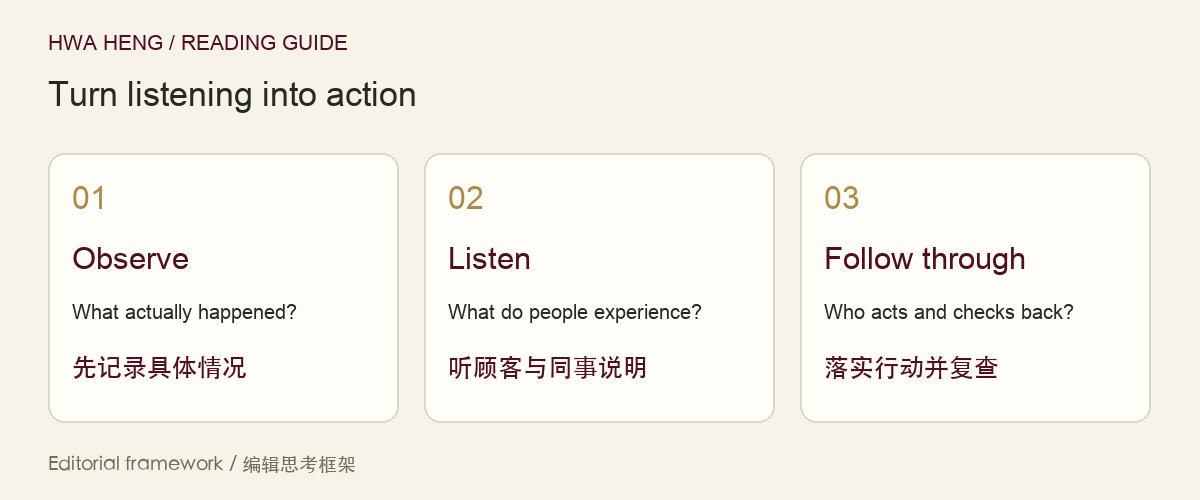
Our editorial suggestion is to begin with a narrow question. Can a first-time visitor understand where to order? Does the collection point make sense when several orders are ready? Watch that part of the journey before deciding what needs to change.
Record what happened separately from the interpretation. “Three customers asked where to collect” is an observation; “the sign is unclear” is a possible explanation. Checking that distinction with the service team helps avoid fixing the wrong problem.
Make it easy to speak honestly
A brief, open question can invite a more useful answer than asking whether everything was perfect. Ask what was easy and what was confusing, without pressuring a customer to respond. Avoid interrupting a meal or collecting personal details when they are unnecessary.
Frontline colleagues should also have space to explain what slows them down. Listen outside the busiest moments, and ask about the process rather than assigning blame. One conversation is a clue, not a representative survey: compare feedback across different shifts and with the information already available.
Close the loop with a small change
Choose one practical adjustment, name the person responsible and set a review date. For example, a team could trial clearer collection instructions and then check whether the same question continues to arise. Keep the original observation so the review has something concrete to compare.
For anyone assessing a multi-outlet business, a useful question is how a concern travels from the counter to a decision—and how the outlet learns what happened next. Being present matters; showing that feedback has been considered makes that presence more meaningful.
Three takeaways
- Observe before diagnosing.
- Hear both customers and colleagues.
- Assign an action and return to check it.
回到门店现场,听见管理报表之外的声音
听见顾客的意见只是起点。把问题变成具体行动,再回头确认效果,才能让交流真正帮助门店改善。
管理报表能够显示一天的经营表现,却未必说明顾客在哪个环节不知如何点餐,或员工为什么需要反复解释同一件事。到门店现场看看、听听,可以补上数字之外的体验。
AsiaOne在11月2日刊登了Hedy Khoo的报道,原文来自《海峡时报》。报道介绍,莆田创办人方志忠自10月初回到吉真那路旗舰店担任店长,日常工作包括迎接顾客和查看厨房。这则近况,让我们重新思考管理层如何与日常服务保持联系。
先看清一个环节
我们的编辑建议是,从一个范围明确的问题开始。第一次来的顾客,是否知道在哪里点餐?几份餐点同时准备好时,取餐位置是否容易理解?先观察顾客怎样经过这个环节,再判断要改什么。
记录时,应把事实与推测分开。“有三位顾客询问在哪里取餐”是观察;“指示牌不清楚”则是一种可能的解释。与服务团队核实两者的区别,有助于避免解决了错误的问题。
让大家愿意说实话
比起问“是不是一切都很好”,简短、开放的问题往往更容易得到有用的回答。可以问哪些地方顺畅、哪些地方不明白,同时让顾客自由选择是否回应。不要打扰用餐,也不必收集无关的个人资料。
一线同事同样需要机会说明哪些环节拖慢工作。避开最忙的时段,把讨论放在流程上,而不是先追究个人责任。一次交谈只是线索,并不等于有代表性的调查;应结合不同时段的反馈与现有资料,再作判断。
用小改动回应,再回来确认
选定一项可执行的调整,明确负责人和复查日期。例如,团队可以先试用更清楚的取餐指示,再观察同样的问题是否仍然出现。保留最初的记录,复查时才有具体的比较依据。
对正在了解多门店业务的人来说,一个值得问的问题是:柜台收到的意见,怎样传到能作决定的人手中?之后,门店又如何知道处理结果?到场很重要;让团队看见意见被认真考虑,才让这种参与更有意义。
三个重点
- 先观察,再判断原因。
- 同时听取顾客与同事的意见。
- 落实负责人,并回头检查效果。
- Hedy Khoo, AsiaOne — Putien founder profile · 2 November 2026 · read 4 November 2026 · originally published in The Straits Times
Industry Insights: the observation and feedback framework is our editorial analysis, not a description of Putien’s internal procedures or a claim about Hwa Heng’s operating results. / 观察与反馈框架属于编辑观点,并非莆田内部程序介绍,也不代表华兴的经营成果。